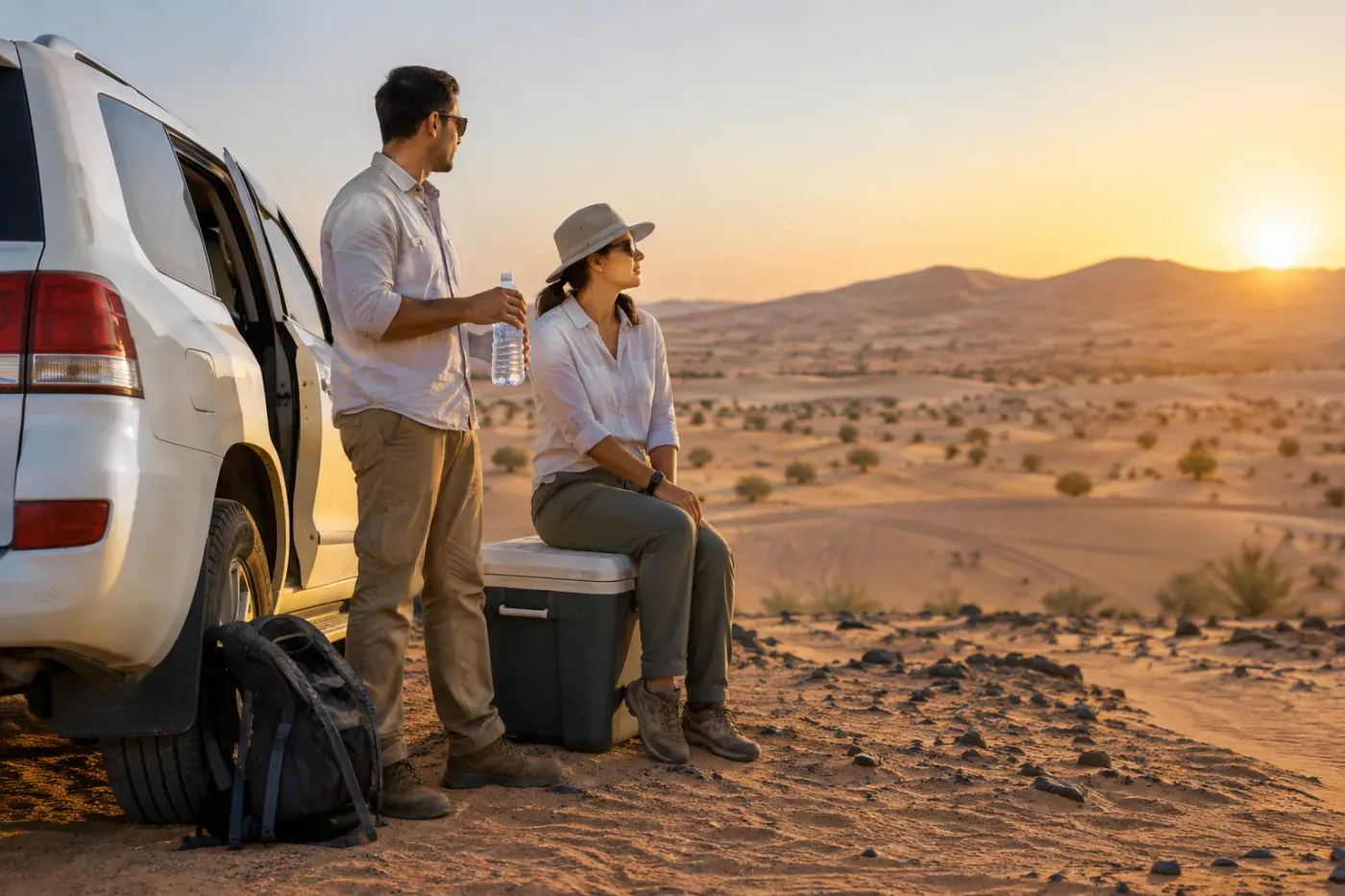
Desert Safety
Never go alone, tell someone your plan, carry 5L water per person, stick to tracks, and know snakes and scorpions exist.
The desert punishes the casual
Organised safaris handle safety for you — licensed operators, convoy discipline, camp infrastructure, guides who read dunes like text. This guide is for everyone else: self-drivers, campers, hikers and photographers heading beyond the graded tracks. The desert here is genuinely hazardous to the unprepared: summer ground temperatures that melt footwear adhesive, winter nights near freezing, zero water, patchy signal, and distances that swallow bad estimates whole.
The non-negotiable system: never go alone (minimum two vehicles for driving, groups for hiking), file your plan with someone expecting your return call, carry 5 litres of water per person per day plus vehicle reserve, and stay on established tracks where recovery is possible. Tell the hotel reception your destination and expected return — it costs nothing and has triggered rescues.
Heat, wildlife and getting stuck
Heat is the primary killer: travel October to April for serious desert time, move only in early morning or late afternoon, and treat midday summer desert as simply off-limits. Wildlife is a minor but real factor — Arabian sand vipers, scorpions and camel spiders exist: shake out shoes and bedding, zip tents fully, watch where hands and feet go on rocks and firewood, and photograph snakes from well back. None hunt humans; all defend themselves.
Stuck vehicles end more trips than anything else: deflate tyres for sand (15–18 psi), carry a shovel, traction boards, tow rope and a compressor, and never spin wheels deeper — stop, assess, dig, boards under driven wheels, gentle throttle. No gear and no second vehicle means no leaving the graded road, full stop. Phone signal dies in dips and behind dunes; offline maps, a power bank and (for remote Liwa crossings) a satellite communicator close the gap.
Camping and night driving
Overnight desert camping rewards the prepared disproportionately: winter skies far from city glow deliver genuinely world-class stargazing, and dawn over dunes justifies every logistical hassle. Camp on firm ground above wadi flood lines, anchor tents against night winds that arrive unannounced, store food sealed against foxes and cats, and keep a lit lantern at the tent door for navigation. Fires only where explicitly permitted, fully extinguished with water, never buried coals.
Night driving off-road is for experts with spotlights, not visitors with headlights: dune faces hide completely in high-beam shadows, and rollovers cluster after dark. Plan to be parked at camp a full hour before sunset, headlights off, kettle on — the desert evening show needs no driving at all.
Desert checklist
- Two vehicles minimum; solo driving off-track is never worth it.
- Five litres of water per person per day, plus vehicle reserve.
- File your route and return time with someone reliable.
- Deflate tyres, carry shovel, boards, rope and compressor.
- Shake shoes and bedding; zip tents; photograph wildlife from distance.
❓ Common questions
Is a normal car okay for desert roads?
For graded tourist tracks (Mleiha, Fossil Rock viewpoints), yes carefully. For dunes, only 4x4s with deflated tyres and recovery gear.
When is desert season?
October to April for comfort; summer desert is for sunrise-only operators and air-conditioned camps, not self-driving.
Are there dangerous animals?
Sand vipers and scorpions exist but encounters are rare with basic precautions. Camels on roads at dawn and dusk are the bigger driving hazard.
What if we get stuck with no signal?
Stay with the vehicle (shade, visibility), ration water, wait for traffic on any track — and this is exactly why you filed a return time with someone.
Can beginners join dune driving?
As passengers with licensed operators, absolutely. As drivers, only via proper desert-driving courses, never by improvisation.
Still have questions about this?
Our Dubai-based team answers on WhatsApp in ~5 minutes, 24/7.