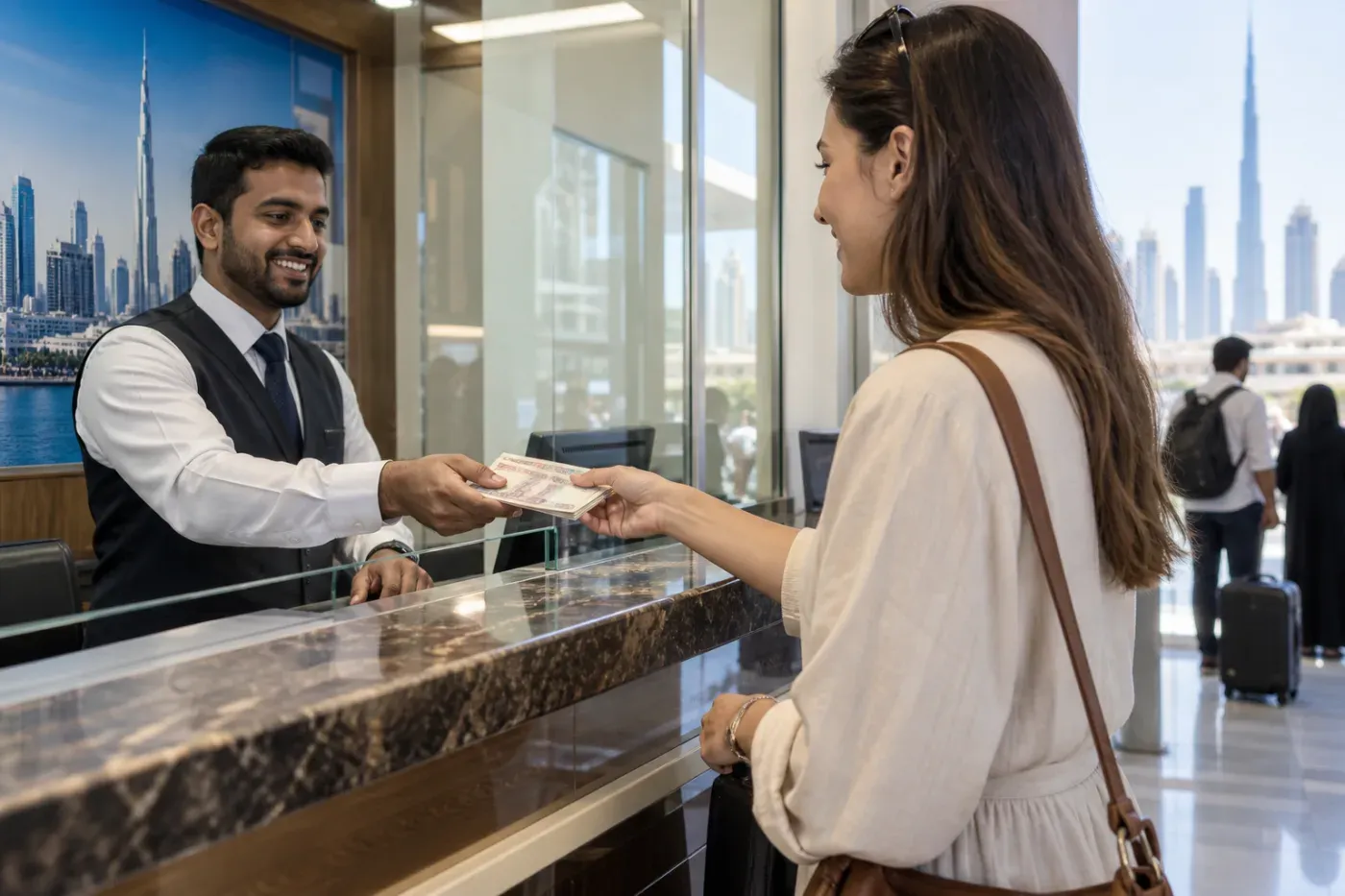
Money Exchange
Best rates at Al Ansari Exchange and UAE Exchange. Avoid airport exchange. Gold Souk area has the best rates.
Where the rate is best
The exchange hierarchy in the UAE is steep and consistent. Dedicated exchange houses — Al Ansari, UAE Exchange (Al Fardan), Al Rostamani — post the tightest spreads in the country, particularly the high-competition branches around Deira, Bur Dubai and the Gold Souk, where rival shops undercut each other all day. Banks come next with fair but padded rates, and hotel desks trail behind. Airport counters sit firmly last: convenient, fast, and priced accordingly — use them only for a starter AED 200 if you land cashless.
Rates also vary by currency corridor. USD, EUR, GBP and INR move on razor-thin margins everywhere; exotic currencies widen spreads dramatically, so holders of less-traded currencies should exchange once, in a large amount, at a competitive Deira branch rather than nibbling in hotels. Gold Souk area shops famously quote the city best rates — worth the metro ride for four-figure exchanges.
How to exchange like a local
Bring clean, recent-design, high-denomination notes: crisp USD 100s and EUR 50s fetch better rates than small, worn bills, and some shops discount damaged notes outright. Compare two adjacent shops before committing — boards update through the day and a five-minute walk routinely buys an extra percent. Count the dirhams at the counter before leaving, keep the receipt, and never hand currency to anyone outside a licensed shopfront, however friendly the approach near tourist zones.
For larger sums, ask about same-day transfer or manager rates; exchange houses negotiate above roughly AED 10,000 equivalent. And remember the alternative: withdrawing dirhams from a bank ATM on a zero-fee card often beats every cash-exchange counter except the very best Deira boards.
Exchanging back and leftover strategy
End-of-trip dirhams convert back at the same houses with the spread applied in reverse — efficient for large sums, wasteful for pocket change. The smarter play is spending down deliberately: coins and small notes go first on final-day souvenirs, karak runs and tips, one 50 survives for airport incidentals, and anything remaining spends at par in duty-free. Never change money twice (home currency to dollars to dirhams) unless the corridor demands it; every conversion layer takes its cut.
Receipts matter more than travellers think: keep exchange slips until departure in case of counter disputes, photograph large transactions, and never let cash out of sight during counting. Licensed houses operate under camera coverage and written rates — insist on both, every time, and walk away from anyone discouraging the receipt.
Exchange checklist
- Exchange houses first (Al Ansari, Al Fardan, Al Rostamani); airports last.
- Gold Souk and Deira branches compete hardest — go there for big amounts.
- Carry clean high-denomination notes; damaged bills get discounted.
- Compare two shops, count cash at the counter, keep the receipt.
- Benchmark against a bank-ATM withdrawal on a zero-fee card.
❓ Common questions
Should I exchange before leaving home?
Only a token amount. Home-country rates for dirhams are poor; land with USD/EUR/GBP or a good card and exchange in Dubai.
Are exchange shops safe?
Licensed houses are regulated and safe. Avoid street touts offering better rates — the classic short-count scam.
Can I exchange leftover dirhams back?
Yes, at the same houses (spread applies both ways). Small leftovers spend perfectly at the airport duty-free instead.
Do shops accept foreign cash?
Essentially never, outside airport duty-free. Exchange first, then shop.
What ID do I need?
Passport for larger transactions; small exchanges often need nothing. Keep ID handy regardless.
Still have questions about this?
Our Dubai-based team answers on WhatsApp in ~5 minutes, 24/7.